Art Nest: Public Art at TOAF
Art Nest 2025 at the Toronto Outdoor Art Fair
Curatorial Statement
I’m thrilled to be curating this year’s Art Nest exhibition, which brings large-scale and thought-provoking installations to the public. Art Nest offers a rare opportunity: a space where emerging curators and artists engage directly with public art. These works aren’t made for quiet contemplation in white cubes – they’re placed into the bustle and noise of urban life. That shift changes the stakes. It asks artists to think not only about form and concept, but about visibility, execution, accessibility, and risk.
This year’s artists were selected for the ambition of their practices and the clarity of their proposals. Each one pushes material limits while opening up space for dialogue. As their artworks take shape, I’m excited to share a few thoughts on the nature of their work.
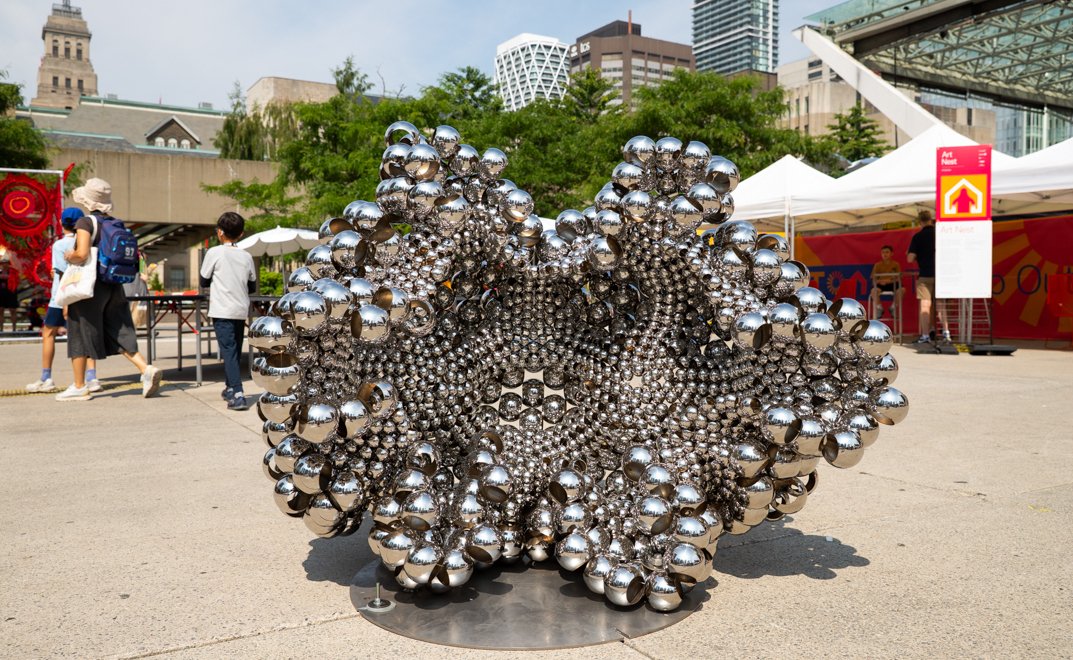
Sharl G. Smith is building a freestanding sculpture from oversized stainless steel beads and aircraft cable. She and her team undertake the arduous task of weaving under tension, creating a structural tapestry that feels both solid and ephemeral. Drawing on physical forces, she composes a visual language that reminds us how our world is built – one knot, one strain at a time.
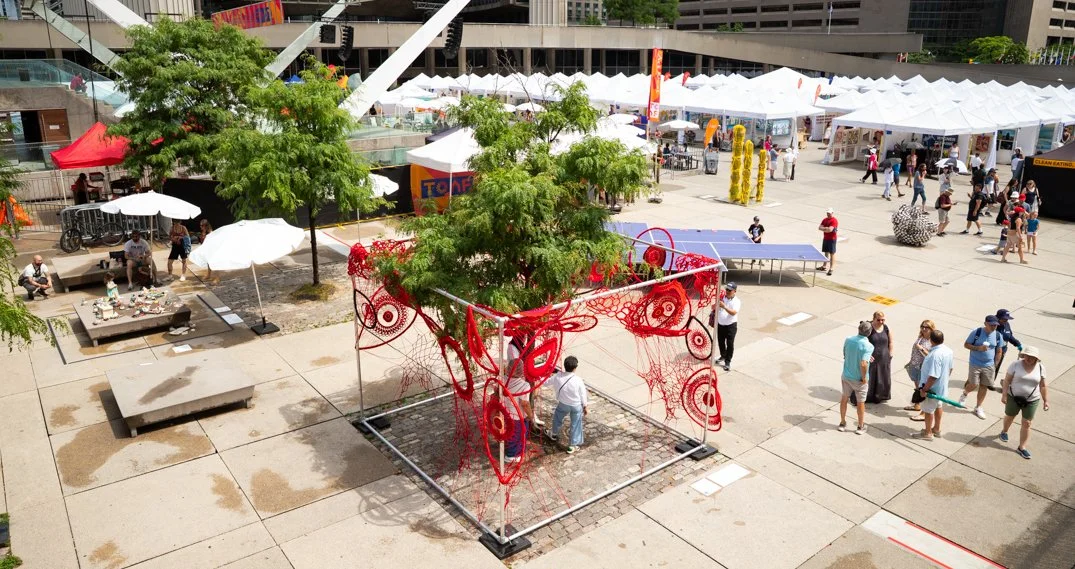
Tracey-Mae Chambers will create a large-scale woven yarn installation that spans across two trees in the Art Nest square. Her red yarn works speak to belonging, identity, and decolonization. They offer a “soft” intervention in an urban setting, inviting viewers to step in, pause, and reflect.
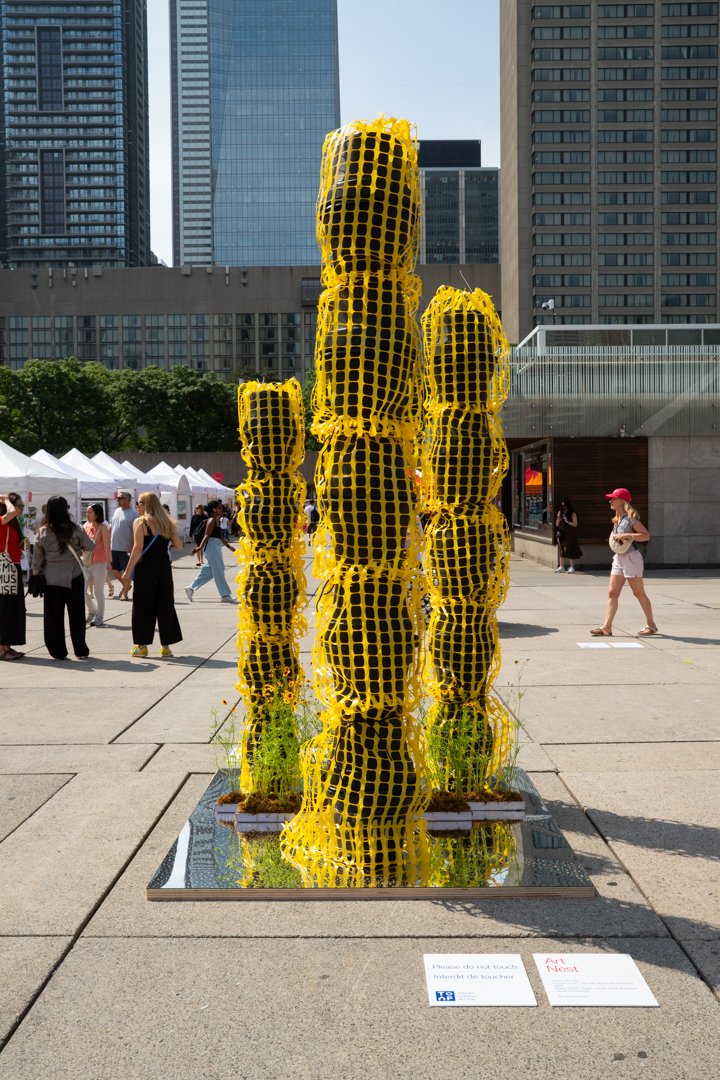
Svava Juliusson’s practice begins with the ordinary: rope, cable ties, and for Art Nest, plant pots – everyday objects drawn from her immediate environment. Her process is one of attaching one thing to another until a familiar shape emerges, a method that collides with ideas of landscape and domestic space. Her gestures repeat, iterate, and insist – not toward uniformity, but toward a quiet transformation, revealing how the monumental might arise from the most familiar things.
Smith, Chambers, and Juliusson alike reframe weaving as a site of strength and transformation. They ask us to reconsider what kinds of work we value – and the kinds of bodies we imagine performing it.
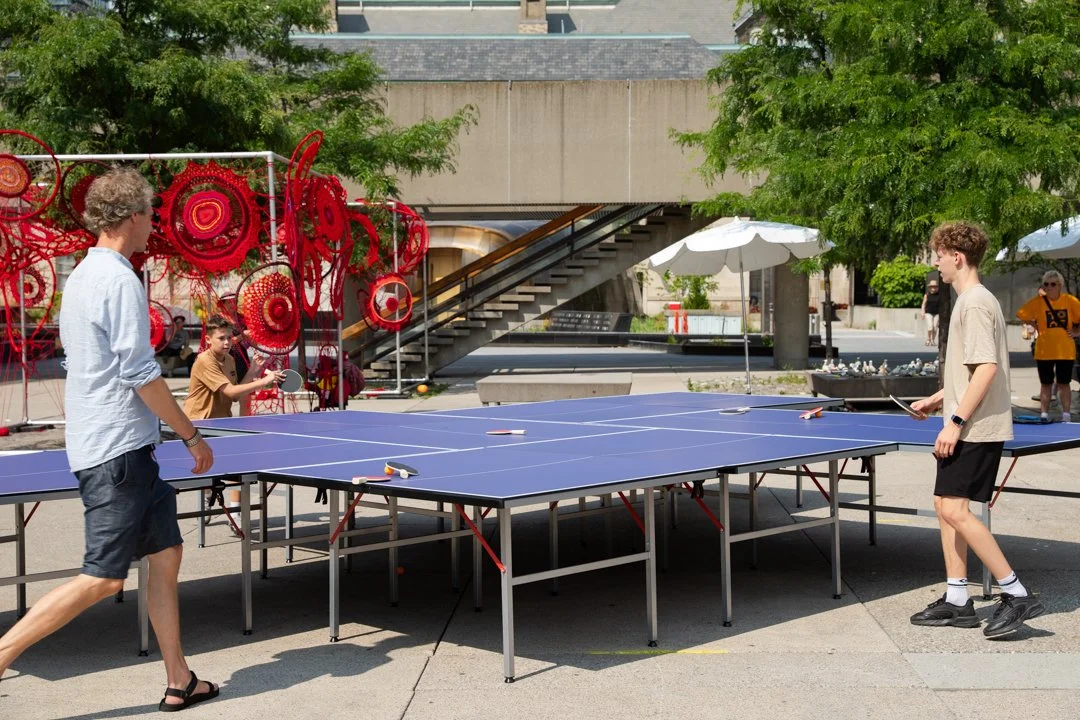
Julia Jamrozik and Coryn Kempster explore the politics of play. For Art Nest, they will rearrange off-the-shelf ping pong tables into a deliberate traffic jam – tables without nets, with no clear sides or direction. The expected flow of the game breaks down; there’s no obvious way to win, and that uncertainty is part of the invitation. The work encourages improvisation and insists on collaboration. Strangers are drawn into a new site of play, where rules are broken and active participation becomes the means through which the game (and art) is continually reinvented.
Jes Young turns to pigeons. They’re creating a porcelain flock in lifelike poses – eating, resting, preening. For Young, pigeons are a metaphor for resilience. Like artists, they persist, even when pushed out or dismissed. Their work is dedicated to those who’ve been “shooed” from spaces and honors those who adapt, endure, and stay.
Young, and Jamrozik and Kempster offer playful interventions that interrupt the seriousness we’re conditioned to bring to art. Their works invite us to play, linger, and look again.
This is my first time working on a curatorial project of this scale, and I’m deeply grateful for the support of Technical Director Calder Ross, the guidance of Mentor Rui Pimenta, and the leadership of Executive & Creative Director anahita azrahimi.
Right now, these works exist as sketches, models, and conversations. The artists are creating them as you read this, and soon, they’ll take shape. I look forward to watching these works emerge, and to sharing more with you as they do.
—Myta Sayo, Art Nest 2025